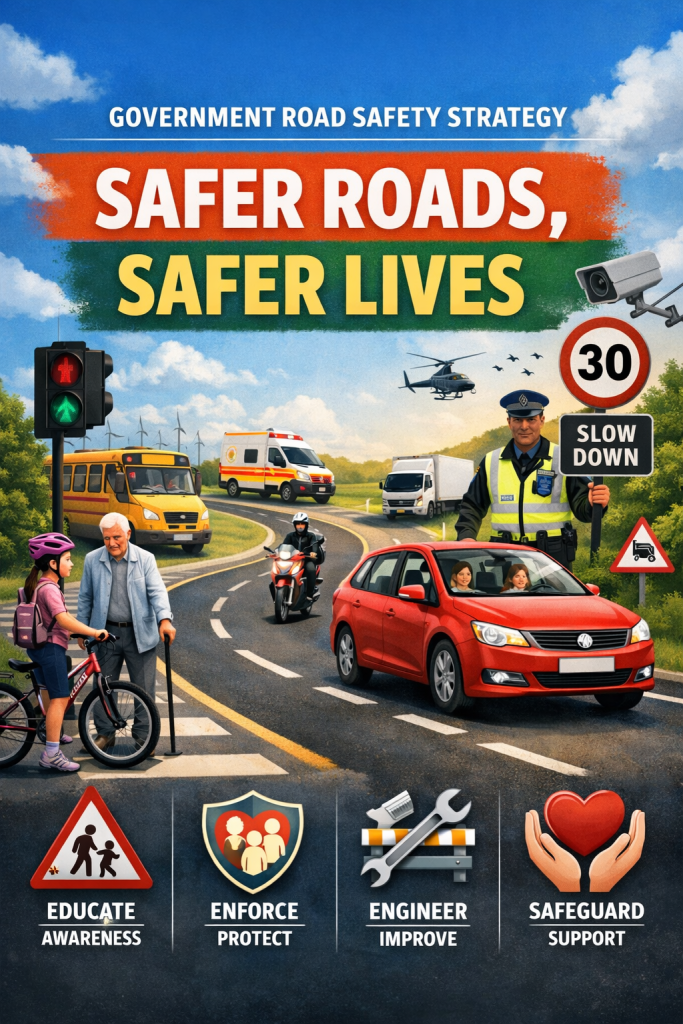
Government Launches First Road Safety Strategy in Over a Decade
The Government has published its first Road Safety Strategy in more than ten years, setting out an ambitious and long-awaited plan to significantly reduce deaths and serious injuries on Britain’s roads.
The strategy commits to a 65% reduction in road deaths and serious injuries by 2035, with an even more ambitious target of 70% for children under the age of 16. If delivered effectively, the actions arising from the strategy have the potential to save thousands of lives over the coming decade.
We are pleased to have been recognised as a key contributor to the delivery of this strategy and welcome the renewed national focus on road safety.
A New National Charter for Work-Related Road Safety
A major commitment within the strategy is the development of a National Work-Related Road Safety Charter, which will be piloted for businesses that require people to drive or ride as part of their work.
The Charter will apply across a wide range of vehicle types, including HGVs, light goods vehicles (LGVs), cars, motorcycles, e-cycles and cycles. Its aim is to reduce work-related road risk and improve safety for all road users.
The Charter will be developed collaboratively with business and industry and will draw on established schemes such as:
- National Highways’ Driving for Better Business programme
- Transport for London’s Meal and Grocery Delivery Motorcycle Road Safety Charter
- DVSA’s Earned Recognition Scheme
- The TyreSafe programme
It will promote good practice, strengthen accountability for organisations and workers, and support positive safety culture change. During the initial two-year pilot, success will be measured through organisational engagement, early safety impacts and cultural change. The strategy also makes clear that regulatory measures may be considered if voluntary engagement does not sufficiently reduce work-related road risk.
A Broader, Evidence-Led Approach to Road Safety
Beyond the Charter, the strategy commits to reviewing key policy areas, including the safety of young and novice drivers, older drivers and motorcyclists, to ensure future interventions are smarter and evidence-led.
The strategy is structured around four core themes:
- Supporting road users
- Harnessing technology, innovation and data for safer vehicles and improved post-collision care
- Ensuring road infrastructure is safe
- Robust enforcement to protect all road users
Adopting a Safe System Approach
Over the past decade, 22 European countries have made greater progress than the UK in reducing road fatalities, resulting in Britain slipping from third to fourth place in European road safety rankings.
While vehicle technology has improved significantly, the strategy recognises that human behaviour and human error will always be a factor. As a result, the Government has formally adopted the Safe System approach, which acknowledges that while mistakes are inevitable, deaths and serious injuries are not.
Rather than placing responsibility solely on individual road users, the Safe System approach ensures that road design, vehicle safety, education and enforcement work together to protect everyone who uses the road network.
Your Views Matter
As partners to the Driving for Better Business programme, we are keen to understand your organisation’s views on what the new National Work-Related Road Safety Charter should include. We will be engaging with members as we develop our contribution to this important initiative and look forward to working with you to help shape safer roads for all.
You can read the full Road Safety Strategy on the Government website:
https://www.gov.uk/government/publications/road-safety-strategy
Common Assessment Standard
With more than 22,500 companies now certified to the Common Assessment Standard, Galliford Try has become the latest Build UK member to adopt it for its pre‐qualification requirements. Companies can now obtain certification from any one of the Recognised Assessment Bodies in order to work with a growing list of organisations.
The Common Assessment Standard has two levels of certification – desktop and site‐based – and companies should apply for the appropriate level depending on their trade, size and the requirements of their clients. Once certified by a Recognised Assessment Body, a company does not need to obtain certification again from any others. Instead, they can agree to share their data at no cost with the other Recognised Assessment Bodies so it is visible to more Contractors and Clients. Don’t duplicate: giving permissionto share your data is quick and simple and will help to save time, reduce costs and win work.
The Common Assessment Standard is reviewed every year to ensure it continues to meet the needs of the industry, and the dedicated Common Assessment Standard Review Group has started the review process for Version 6 to be published later this year. To submit any suggested changes, please complete this online form.
AFI Membership Renewals & Certified Contractor Scheme
A quick reminder that membership renewal fees are due by the end of January. To ensure there’s no interruption to your benefits, please make sure your renewal is completed by then.
As part of your renewal, if you send us your updated insurance documents along with a reference (this can be in any format — a social media post, website review, testimonial, message, etc.), we will automatically add Yellow – General Certified Contractor Status to your membership.
If you’re interested in achieving a higher level of Certified Contractor Status, we’re very happy to help — we’ll just need a little additional information from you. Please get in touch and we can guide you through the next steps.
Thank you for being part of the AFI community, and we appreciate your continued support.